White House Doctor Addresses Trump’s Neck Rash Seen At Medal of Honor Ceremony
White House doctor Sean Barbabella clarified the cause of his skin irritation in a statement to the press.
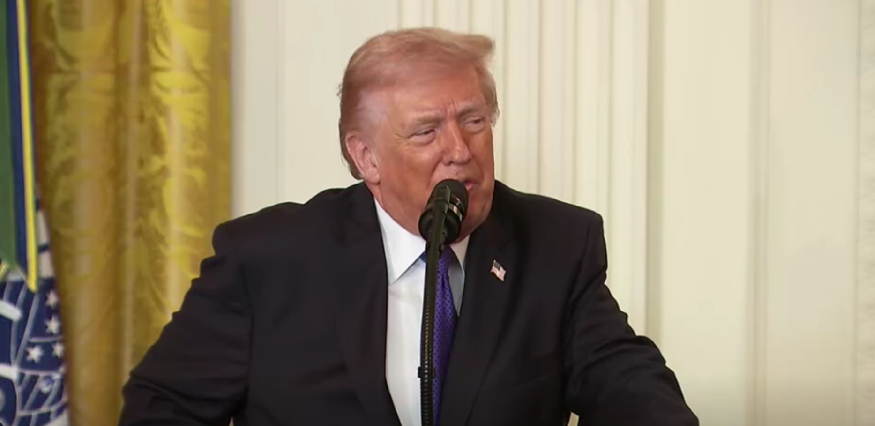
An apparent rash spotted on President Donald Trump's neck at a ceremony has sparked a wave of public interest and concern, causing the White House doctor, Sean Barbabella, to clarify the cause of his skin irritation.
Photographs from the Medal of Honor ceremony held in the East Room of the White House captured close-up images of the discoloration, which at a glance appeared as a large reddish blotch extending above the president's collar. That visual prompted renewed scrutiny online and among journalists, partly because the 79-year-old president's health remains a frequent subject of public discussion due to his age and physical visibility.
Close-up photos of the neck irritation circulating on social media, including platforms such as Instagram and X, show the reddened patch that has become the focus of attention. The visual appearance, which some social posts described as "a new rash on the right side of President Donald Trump's neck," sparked speculation before the White House explanation was released.
whoa -- this is new. Trump has a significant rash-like injury on his neck today in addition to his disfigured hand
— Aaron Rupar (@atrupar) March 2, 2026
(Saul Loeb/Getty) pic.twitter.com/H3PbltNCAE
In an official statement quoted by multiple outlets, Dr. Barbabella said the redness on Trump's neck is the result of a very common skin cream being used as a "preventative skin treatment". Dr. Barbabella wrote, "President Trump is using a very common cream on the right side of his neck, which is a preventative skin treatment, prescribed by the White House doctor. The president is using the treatment for one week, and the redness is expected to last for a few weeks."
The White House did not immediately answer follow-up questions about when the treatment began or what specific ailment it is meant to prevent. Earlier medical documentation from Trump's April 2025 physical noted that he had been prescribed mometasone cream "as needed" for an unspecified skin condition, though it is not confirmed whether that is the same treatment currently in use.
The Trump administration has faced persistent questions about the president's health in recent months, partly because of his status as one of the oldest individuals to serve in the office. Barbabella said in December of last year that routine MRI scans of his heart and abdomen conducted in October 2025 yielded normal results, and overall health was described as "exceptional."
Previous concerns about the president's health have stemmed from bruising spotted on his hands. Earlier this year, Trump gave a detailed interview to the Wall Street Journal about his health and claimed he was taking a higher than recommended daily aspirin dose, which he believes helps prevent blood clots, despite medical advice encouraging a lower dose, causing the bruising.
Trump admitted that he is "a little superstitious" about it and that doctors would "rather have me take the smaller one." He added, "They say aspirin is good for thinning out the blood, and I don't want thick blood pouring through my heart."
In that same interview, Trump also addressed public concerns over a medical imaging procedure he underwent in October. Initially described ambiguously in White House statements, he clarified to the Journal that it was actually a CT scan, not an MRI, and that it showed no abnormalities, according to Barbabella. Trump said he regretted having the scan because he felt it provided "ammunition" for speculation despite reassuring results.
Videos of him apparently falling asleep at major White House events were also dismissed by the president as "Sometimes they'll take a picture of me blinking, blinking, and they'll catch me with the blink." The President also mentioned not having made any changes to his diet, which has long been reported to include a lot of fast food. In the Journal piece, RNC Chair Joe Gruters recalled being "shocked" after seeing Trump eat "french fries, a McDonald's Quarter Pounder hamburger, a Big Mac, and a Filet-O-Fish" all in one sitting.
Originally published on IBTimes
Subscribe to Latin Post!
Sign up for our free newsletter for the Latest coverage!
© 2026 Latin Post. All rights reserved. Do not reproduce without permission.


